
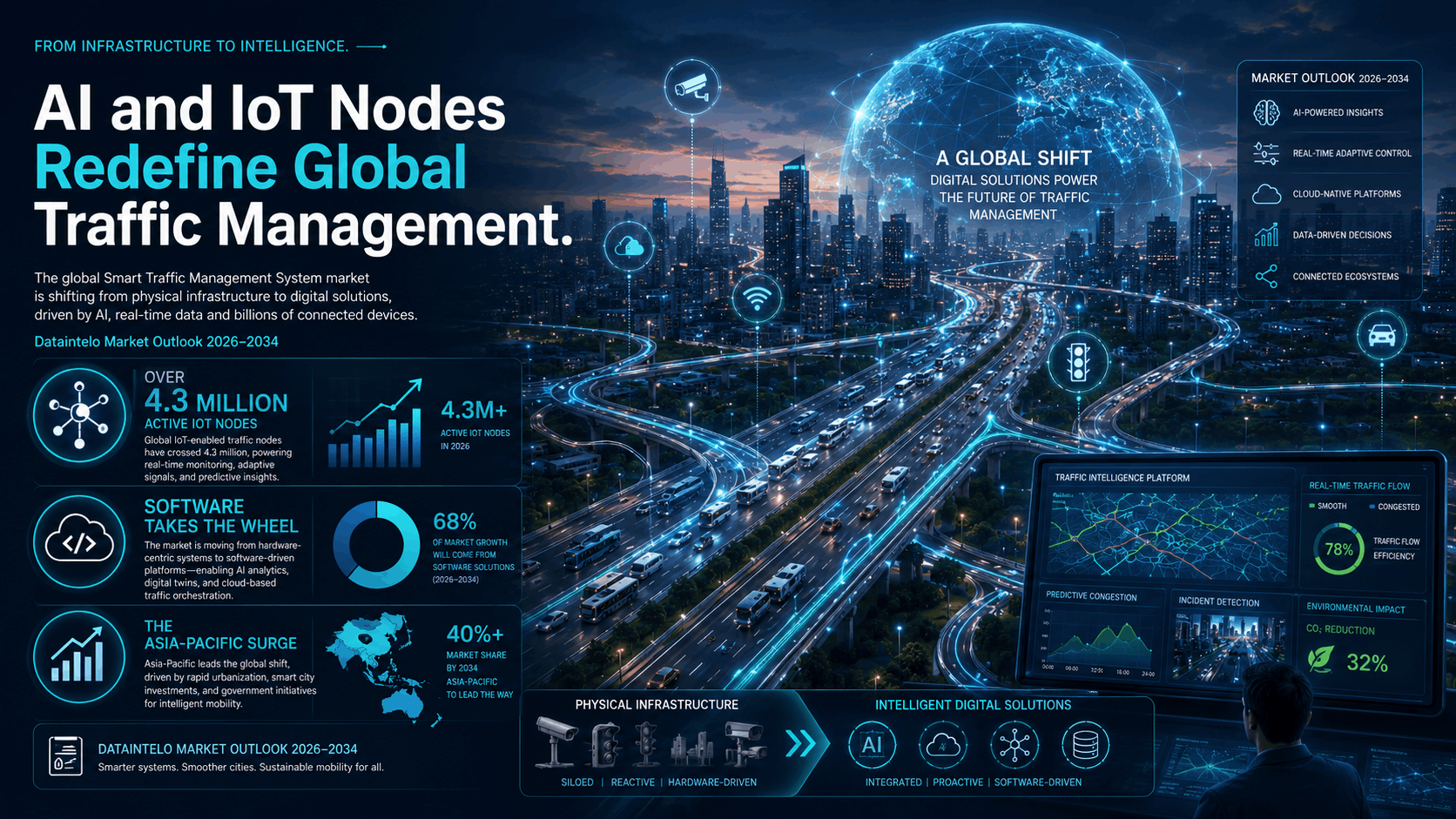
When a city outgrew its roads, the standard response has been to pour concrete — building wider lanes, expansive flyovers and complex underpasses. However, the Global Smart Traffic Management System market outlook for 2026-2034 by Dataintelo reveals a massive structural paradigm shift.
According to a market data, the global smart traffic management ecosystem has scaled past a $15.8 billion valuation. More importantly, the data underscores an entirely new approach to urban congestion: cities are rapidly transitioning away from physical hardware overhauls to software-centric and data-driven management.
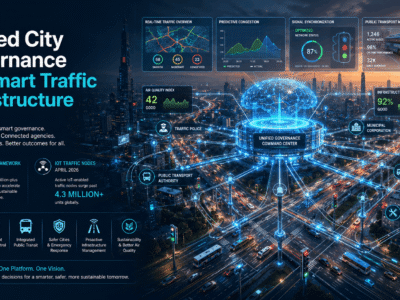
Over 4.3 Million Active IoT Nodes
The most striking revelation from the industrial data is the sheer velocity of connected hardware deployment. By the close of the first quarter, the number of active, IoT-enabled traffic nodes deployed globally surged past 4.3 million units.
These nodes — relying heavily on narrow-band IoT (NB-IoT) and LTE-M cellular modules — are no longer just passive counters. They represent a decentralized network of sensors, connected cameras, and radar units that continuously feed real-time telemetry into centralised city brains.
Instead of relying on static, outdated historical traffic models, traffic management centres (TMCs) are now processing billions of live data points every second to understand how vehicles, pedestrians, and public transit interact.
Software Takes the Wheel
The economic landscape of traffic infrastructure has changed. Software integrations — including AI video analytics, Machine Learning predictive models, and Digital Twin platforms — now make up over 38% of modern traffic ecosystem investments.
This shift toward “software-intensity” allows cities to optimise the infrastructure they already have, bypassing years of construction delays and massive capital expenditures. Rather than waiting for a new flyover to be built, municipal authorities are deploying software layers capable of:
• Dynamic Signal Synchronization: Automatically altering green-light windows based on real-time vehicle queues rather than fixed timers.
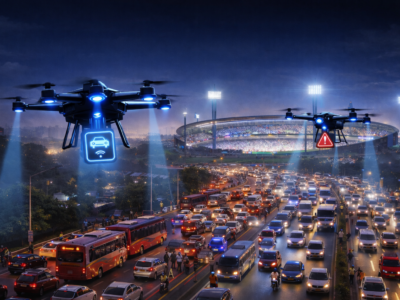
• Incident Detection Automation: Utilizing computer vision on existing CCTV networks to identify accidents, stalled vehicles, or unauthorized parking within seconds, automatically alerting emergency services and altering digital signage to reroute incoming traffic.
• Transit Signal Priority (TSP): Communicating directly with onboard GPS units of city buses to extend green lights, ensuring public transport maintains strict schedules.
The Asia-Pacific Surge
Rapid urbanisation, high vehicle density, and the growth of mega-cities in India, China, and Southeast Asia are forcing local governments to adopt aggressive digital measures.
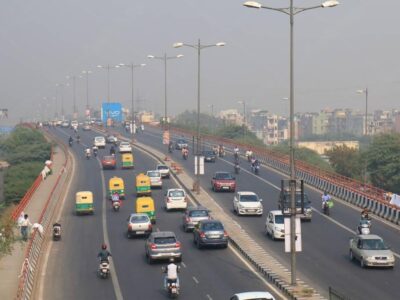
In dense Indian metros, where spatial constraints make physical road widening virtually impossible, software-defined traffic management is transitioning from an innovative policy choice to a survival mechanism. The deployment of AI-driven adaptive traffic control systems (ATCS) across major corridors is proving that smarter algorithmic management can substitute for physical lane capacity.
The data from the global outlook sends a clear message to urban planners, municipal corporations and enforcement authorities: the future of the street is software-defined.
The milestone of 4.3 million active IoT nodes proves that the technical foundation
for smart cities is already on the ground.