
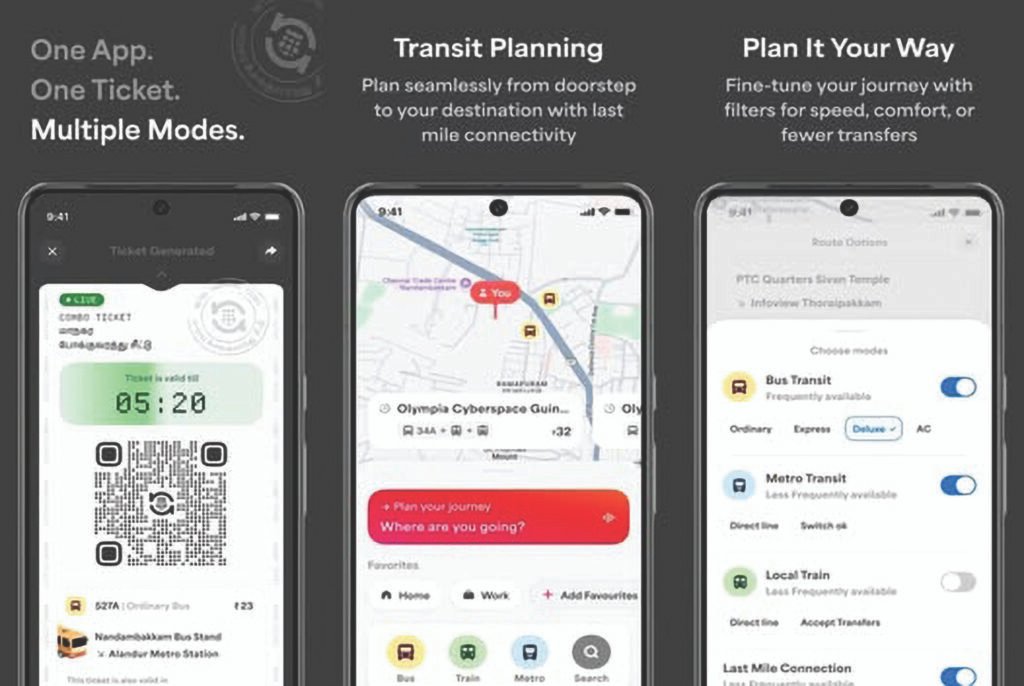
At the Traffic Infratech Expo, I Jeyakumar, Member Secretary, CUMTA, Chennai shared information on Chennai’s urban mobility initiatives, including the Chennai One app, a multimodal journey planner offering single QR-code ticketing across buses, metro, rail, cabs, and autos.
Chennai stands out for its effective parking management…
In Chennai, we have launched ‘Chennai One’, a QR based multimodal transit app integrating journey planner. It was launched by the Chief Minister of Tamil Nadu in September.
The app has received strong reviews, with users responding positively to how intuitive and useful it is. It works much like Google Maps, helping people plan their journey from point A to point B by showing multiple options. Whether it is walking, taking a cab, or switching between metro, bus, and rail, the app brings all modes together and suggests the best possible route. Users can then choose what suits them best. You can also buy a single ticket through one payment, with one QR code that works across all systems.
This is Phase 1 that we have introduced. We have received many suggestions for improvement, and there are several features we plan to add. We are also developing a parking app, which will be a key component of this system. Our aim is to scale up the Chennai One app into a full city app with all functionalities, so that even while driving, users can continue to use it easily.
Is CUMTA developing this app?
CUMTA selected a technical partner to develop the app through an open tender process. However, the domain knowledge, design and overall experience are shared by us. We will pay the technical partner a percentage of the ticket sales. So instead of collecting convenience charges from the customers or passengers, the government is paying the vendor from public funds. Because, the main objective is to promote public transport.
This move can optimise public transport operations…
Yes, because ultimately, what happens every day in every city is that vehicles are increasing rapidly, and road space is limited. The best way to optimize road space is to focus on public transport. We can improve public transport by using an integrated ticketing app. For example: A person in our office used to travel from Kodambakkam to Nandanam. By Uber, the fare was around 172–180 rupees. Through the app, she realized she could take a suburban train from Kodambakkam to Guindy and then the metro to the same office. The travel time remained about 40 minutes, but the cost dropped to just 30 rupees, same time, much more affordable.
This app is a good example, as it offers multiple travel options that users might not have considered. The main feedback we have received is that transfers between different modes of transport take time. To address this, the city is working on seamless multimodal integration. For instance, railway and metro stations should be conveniently connected, with elevators and other facilities to make transfers easy. We are coordinating with all relevant departments, and the system will gradually improve.
CUMTA’s key initiatives…
We have released a mobility plan which is also approved by the government. This is a 25-year visionary statement, covering projects in the short, medium, and long term, including rapid rail systems, high-speed rail, water metro, road networks, metro systems, railways, number of buses, and walkability – footpaths and similar infrastructure.
Every space has been planned in a comprehensive manner. This will serve as a guiding document for officers across departments. We have also recommended the year-on-year implementation process for these projects.
As part of the parking policy, we are developing comprehensive street design guidelines. Suppose you have a road or street, everyone, from engineers to corporation officials, and even the public, usually sees the street as just one component of transport. But we are taking a sustainable approach: how the footpath should be, how the bus bays should be placed, where garbage bins should go, and where electric poles should be located. In many places, electric poles are in the middle of the footpath, causing encroachments and blocking movement. We are addressing every element in a planned manner so that the street functions as an integrated system.
In planning, you have a team of road architects…
We have officers on deputation from various departments, including an RTO, Regional Transport Officer. One Asst. Police Commissioner will also be joining shortly. From the highway department, the corporation, and the bus services, we have representatives. From the railways, one more officer is expected, and from the metro, we will have one officer as well. In short, we have officers from all relevant departments to share domain knowledge and ensure coordination.
Second, we are hiring experts from the open market, such as transport specialists, urban designers, transport engineers and modelers, data architects, environmental specialists, and social experts. We are bringing in the best talent from outside on a fixed-term basis. Later, they may also grow to the next level within the organization.
So, in this way, we have a mix of domain knowledge and the experts currently available in the open market. This allows us to think better and create a clearer vision in the urban mobility space.