
Driving India’s shift to barrier-less tolling, Gaia Smart Cities Solutions Pvt Ltd, appointed as Programme Management Consultant for the MLFF rollout, is deploying high-speed RFID and AI-based vehicle classification to build a robust digital enforcement ecosystem. Leading this transformation, Dr Sumit Chowdhury, CMD, Gaia and National Engineer-in-Charge, IHMCL (NHAI), explains to Mohana M of TrafficInfraTech how MLFF combines technology, enforcement and behavioural change to make faceless tolling a reality.
How would you define the objective of MLFF beyond seamless traffic?
Firstly, MLFF will do away with stopping and queuing at toll plazas. Removing those queues will have a significant impact on the Indian economy. Take, for example, about 1,000 toll booths each taking care of up to 50K vehicles per day. Even if each vehicle stops for just one minute, that adds up to 1,000 minutes multiplied across how-many-ever vehicles pass through daily. That is a huge economic loss — not just to the toll operator or the car driver — it is national wastage.
Secondly, with MLFF, you eliminate the need to slow down at toll plazas. Vehicles can maintain a uniform speed, up to 120km per hour and move seamlessly. You reach home earlier, safe fuel and have a better travel experience.
At a speed of 120 km per hour, can the systems and technology accurately capture the FASTag data?
FASTag is essentially a wallet linked to an RFID based ID. When there is sufficient balance, the deduction happens instantaneously. We assume that 30 to 50% of vehicles will pass through in this “happy path”. The remaining cases will result in an e-challan.
When you receive a challan, you have three days to pay it and avail a 50% discount, because the challan amount is double the toll. It means that if you pay immediately, you receive the 50% discount.
Presently, we have seen instances where there is money in the FASTag but the system fails to detect it, even in the current tolling environment. That issue largely lies with the reading technology.
Current toll plazas often use low-fidelity RFID readers that require manual, close-range scanning. We are now installing high-quality, globally tested readers capable of reading RFID tags at speeds of 100 to 150 km per hour. With a new tag and a reliable reader, accuracy will improve significantly.
In India, about 40% of transactions will follow the happy path. The remaining 60% will involve exceptions like incorrect data in Vahan, tampered number plate, or fancy number plates. Our job is not just to make the 40% work — that part is relatively straightforward. Our job is to design systems that detect, manage and enforce the remaining 60%.
Old tags — sometimes even 10-year-old tags — can be difficult to read. Therefore, part of our work involves educating road users that they will be penalised with double the toll amount in case of insufficient balance. Many people may not be aware of this and could receive challans in the initial days.
If the toll remains unpaid, the Central Motor Vehicles (Second Amendment) Rules, 2026 mandate that no No Objection Certificate (Rule 58), no Transfer of Ownership (Rule 55), no Fitness Certificate renewal (Rule 62), and no National Permit (Rule 90) shall be granted until the unpaid user fee is cleared, as notified under G.S.R. 28(E) dated 13 January 2026. (GSR 28 E dated 14.01.2026 – IHM…) A road usage charge is treated as a statutory payable, similar to other regulatory dues linked to vehicle compliance.
This is essentially tightening the strings. For technology to work, behavioural change must accompany it. It is a two-way process.
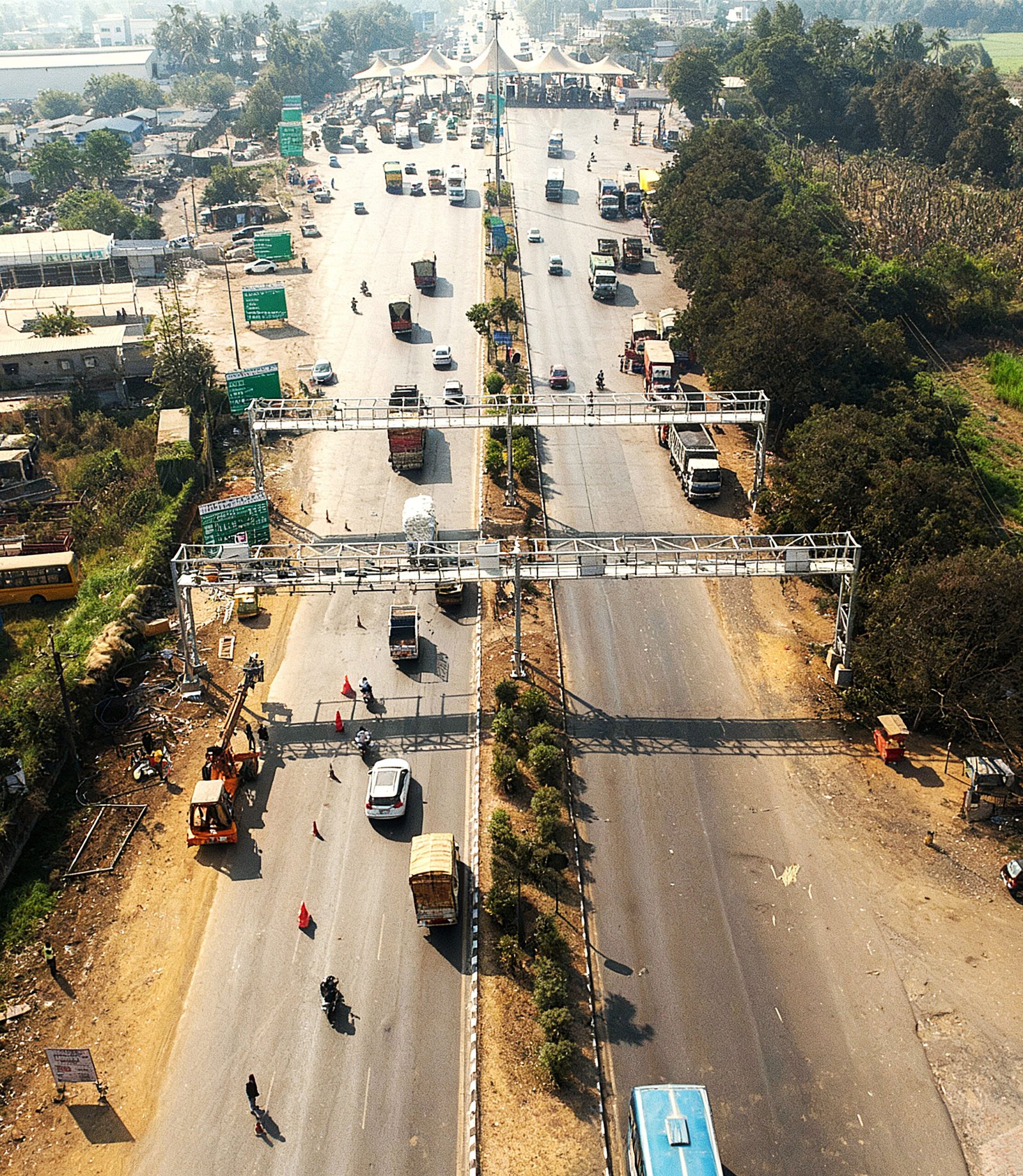
Our first gantry is almost ready for launch. We are currently running trials at Choryasi Toll Plaza just outside Surat, Gujarat.
Two or three other gantries are also ready, with slightly staggered delivery schedules. About 14 or 15 locations have already been tendered out. The first four will involve five different banks and five different technology providers executing the programme.
The system links banks and systems integrators as well
The tender structure designates the acquiring bank as the prime entity for each toll plaza. The acquiring bank must partner with a technology provider that has prior tolling experience. These are typically international organisations with operational experience in countries such as Taiwan, Germany and Spain.
They jointly quote a per-unit transaction rate for toll collection. The contract is awarded on a single unit price per vehicle pass-through, with the lowest technically qualified bidder emerging as L1.
However, this is not purely price-based. Technical qualification comes first. Only bidders who meet stringent technical criteria — including proven capability in RFID systems, high-speed camera reading and LIDAR-based classification — are eligible to compete on price.
Welcome to India’s MLFF Era – Technology with Behavioural Enforcement “Miss a toll under India’s MLFF system and it will not just mean a fine — unpaid user fee can block Transfer of Ownership (Rule 55), No Objection Certificate (Rule 58), Fitness Certificate renewal (Rule 62) and National Permit issuance (Rule 90) until dues are cleared. (GSR 28 E dated 14.01.2026 – IHM) Barrier-less tolling is about speed, but statutory enforcement is its backbone.” – Sumit Chowdhury
Automated tolling requires accurate vehicle classification. Today, classification is done visually. Under MLFF, a combination of cameras and LIDAR performs this function, categorising vehicles into six tollable classes — cars, light commercial vehicles, trucks, buses and multi-axle vehicles — while exempting non-tollable vehicles such as bicycles, scooters, auto rickshaws and certain farm equipment.
The shift in technology…
Today’s toll cameras read vehicles that have almost come to a standstill. It is easy to capture a number plate when a vehicle is barely moving.
Here, we are reading vehicles travelling at 100 km per hour. That requires entirely different technology. A regular surveillance camera cannot perform that task. We need Global Shutter Box Cameras to do this function effectively.
We are reading the number plate at high speed, reading the FASTag ID simultaneously, correlating the two, integrating LIDAR inputs and stitching everything into a single event. If there is balance, the toll is deducted. If not, enforcement is triggered. Even if the FASTag is not captured but the number plate is, the system can reverse-map the vehicle and process the charge. It works both ways.
How is data security ensured?
Comprehensive guidelines govern data security at the plaza level and during transmission to the acquiring bank’s server. Once the data enters the banking network, it falls under stringent banking security protocols.
The key responsibility lies in securing plaza infrastructure and encrypted data transmission. As programme consultants, we conduct cybersecurity audits and certify systems before launch.
What other technologies are involved?
Beyond RFID and ANPR, the system integrates OCR, LIDAR and radar. India still lacks complete licence plate standardisation despite the HSRP mandate, especially in rural areas. Therefore, image capture and interpretation are critical. OCR, enhanced by AI, converts images into validated data, which is then cross-checked with the Vahan database.
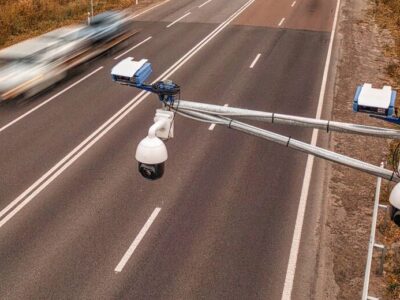
There are three sets of cameras:
1. Number plate reading cameras
2. Side-mounted cameras combined with LIDAR for classification
3. Audit cameras mounted atop gantries for fallback recording
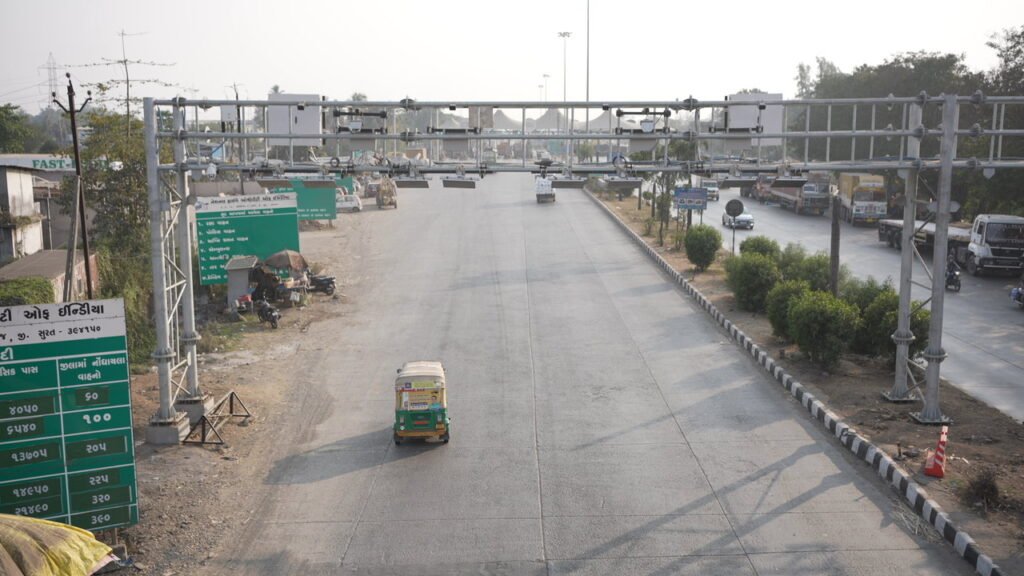
Each location has two gantries — primary and backup — typically 50 to 100 metres apart.
Radars can detect approaching vehicles from up to 800 metres and trigger the event sequence. All data points are stitched into a single consolidated transaction event — either tolled or converted into a challan. Our objective is to reduce and eliminate transactions that we do not know what to do with.
With multiple data sources available, pinning down on one could be difficult.
That is the core challenge in India. There is no single source of truth. If FASTag, Vahan and classification all align, that accounts for about 40% of transactions. The complexity lies in the remaining 60%, where discrepancies arise.
The system operates on confidence modelling, evaluating multiple inputs in real time to determine the most reliable source.
We are coding as many real-world scenarios as possible before launch. Can we anticipate everything? Probably not. Thailand, for instance, took six months to stabilise after technical readiness — and that was for a single road. We are launching across 15 locations with five vendors using different technology stacks. The complexity is far higher.
When do you see toll plazas disappearing?
About three to four years. The constraint is logistics and civil engineering. Gantries must withstand vibration, wind loads and extreme weather. A shaking structure affects camera accuracy. This is highway infrastructure in 40-degree outdoor conditions, not a controlled indoor setup.
What about backend manpower?
Each cluster will have a command centre handling exception cases. Perfect matches proceed automatically. Discrepancies fall back to manual verification, sometimes requiring dual confirmation.
A traditional toll plaza may employ around 100 people across shifts. MLFF may require only eight to ten backend staff per location.
Some workforce reduction is inevitable, but many can transition into higher-skilled technical and maintenance roles. Increased traffic velocity will generate wider economic benefits — just as removal of excise border controls once did.
There are SOPs for maintenance?
SOPs are in place and NHAI programme managers are being trained.Faceless tolling removes direct confrontation between motorists and operators. While equipment damage risks exist, the human friction is eliminated.
The technology is mature. AI capabilities have improved significantly. We are confident the system will work.