
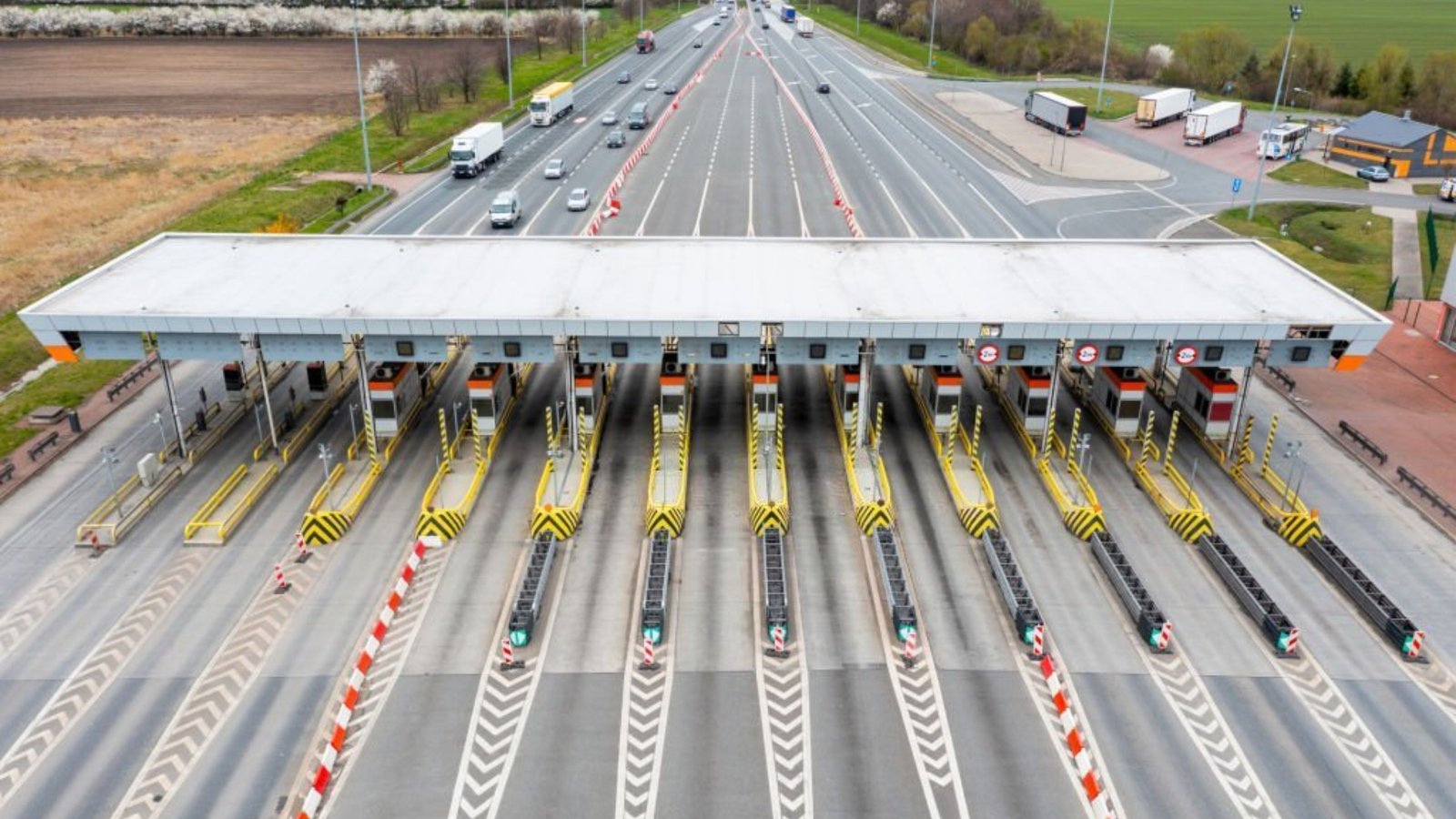
India’s highway network is rapidly adopting Multi-Lane Free Flow (MLFF) technology, with NHAI planning the rollout of 200+ MLFF plazas. While the primary driver is seamless tolling, MLFF gantries equipped with ANPR cameras, RFID readers, LiDAR-based AVC sensors, and AI analytics represent a powerful national infrastructure layer that can serve purposes far beyond revenue collection. In this the first of the series of essays on MLFF, Sachin Bhatia, Founder & CEO, Metro Infrasys Pvt. Ltd. explores these value-added applications by bringing together domain experts, practitioners, and policymakers to examine how MLFF infrastructure can be leveraged for public safety, urban mobility, environmental compliance, and national security. This article focuses on one of the most pressing concerns of law enforcement: the use of stolen vehicles in the commission of serious crimes.
The Problem: Stolen Vehicles as a Tool of Crime
Across India, law enforcement agencies face a recurring and deeply frustrating pattern: a serious crime — robbery, kidnapping, terrorism, organised theft — is committed, and the vehicle used by the perpetrators is found abandoned days later, often hundreds of kilometres from the crime scene. By then, the trail has gone cold.
The reason stolen vehicles are the preferred tool of criminals is straightforward. A stolen vehicle, especially one with a cloned or switched number plate, provides near-perfect anonymity on the road. Traditional enforcement relies on police nakas, human observation, and tip-offs — all of which are reactive, resource-intensive, and easily evaded by a determined criminal who simply avoids known checkpoints.
According to data from the National Crime Records Bureau (NCRB), India reports approximately 150,000–200,000 vehicle theft cases every year. A significant subset of these stolen vehicles are used in crimes before being abandoned or dismantled. The challenge for law enforcement is not identifying the vehicle after the fact — it is intercepting it in real time, before the crime occurs or immediately after.
The Core Investigative Gap
In most stolen vehicle crime cases, law enforcement knows the make, model, and original registration of the stolen vehicle — but lacks a mechanism to detect its movement across the highway network in real time.
MLFF infrastructure, already being deployed at scale across national highways, is uniquely positioned to close this gap.
The Opportunity: MLFF Gantries as a National Vehicle Detection Network
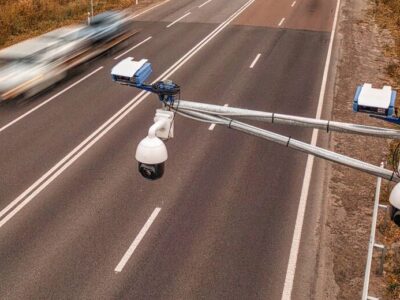
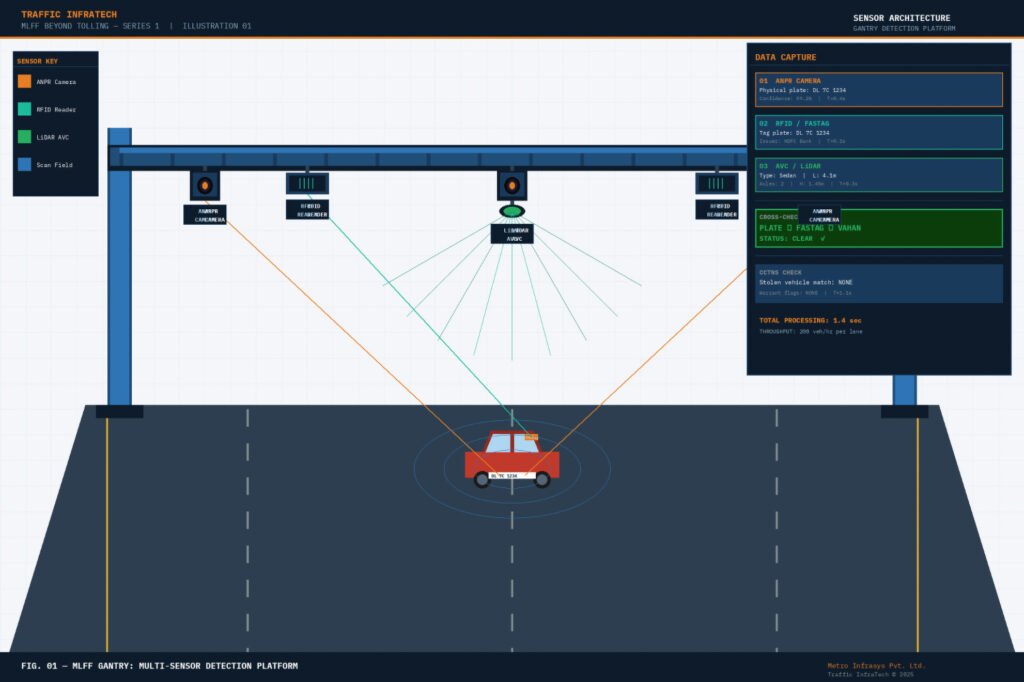
An MLFF gantry, at its core, is a multi-sensor observation point positioned above a highway lane. Every vehicle that passes beneath it is simultaneously observed by:
• ANPR (Automatic Number Plate Recognition) cameras — capturing the physical number plate in real time.
• RFID readers — reading the FASTag transponder affixed to the vehicle, which is linked to a registered vehicle number in the Vahan database.
• AVC (Automatic Vehicle Classification) sensors — using LiDAR, stereo cameras, or radar to determine the vehicle’s make, model, axle count, and dimensions.
In a standard tolling transaction, these three data streams are reconciled to debit the correct toll. But the same data — physical plate, digital plate (FASTag), and vehicle fingerprint (make/model/dimensions) — can be used to run a powerful set of security checks in the background, without any disruption to traffic flow.
How the System Works: A Step-by-Step Illustration
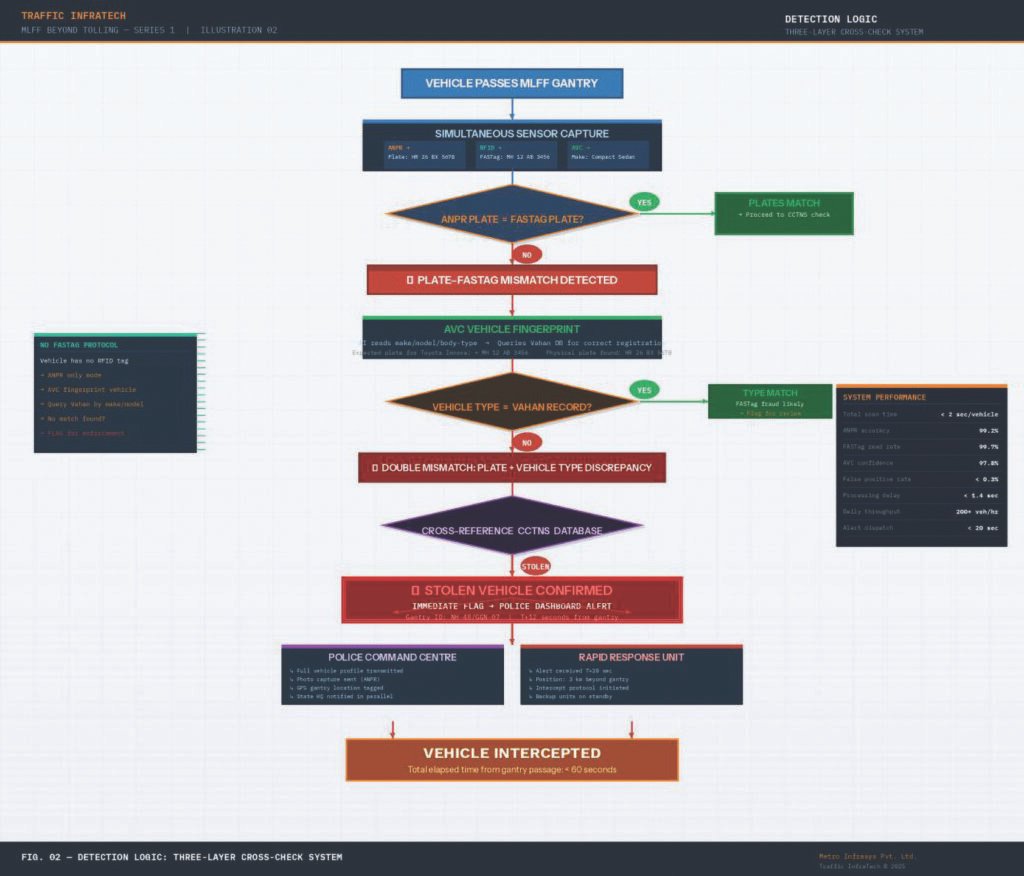
The following illustrates how MLFF infrastructure can detect a stolen vehicle or a vehicle with a cloned/mismatched number plate — the two most common configurations used by criminals.
1 Vehicle passes under
MLFF gantry
2 AI reads physical number plate (ANPR camera)
3 System reads RFID FASTag — extracts registered number
4 Cross-check: Does physical plate = FASTag plate?
5 MISMATCH? → AI reads make/model via AVC/LiDAR
6 Query Vahan DB: What plate is registered for this make/ model?
7 Flag discrepancy → alert police dashboard in real time
8 Rapid Response Unit intercepts vehicle beyond gantry
Step 1 — The Vehicle Passes the Gantry
As a vehicle travels on a national highway and passes beneath an MLFF gantry at normal highway speed, the sensor suite captures all relevant data within milliseconds. There is no slowing down, no toll booth, no human interaction.
Step 2 — ANPR Reads the Physical Plate
High-resolution ANPR cameras read the physical number plate affixed to the front and/or rear of the vehicle. The number is extracted using optical character recognition (OCR) and validated against Indian registration number formats.
Step 3 — RFID Reader Captures the FASTag
Simultaneously, an RFID reader interrogates the FASTag transponder on the windscreen. The FASTag is linked to a registered vehicle number in the Vahan central database — this is the number plate under which the vehicle is registered with the transport authority.
Step 4 — The Critical Cross-Check
The AI system performs the primary security check:
Primary Check: Plate-Tag Match
Physical plate (from ANPR) = Registered plate (from FASTag)?
✓ MATCH → No anomaly. Transaction proceeds normally.
✗ MISMATCH → Proceed to secondary investigation.
A mismatch at this stage means one of the following: the vehicle is carrying a cloned plate, the FASTag belongs to a different vehicle (FASTag fraud), the vehicle is stolen and the original plate has been replaced, or the FASTag has been tampered with.
Step 5 — Secondary Check: Vehicle Fingerprinting
When a plate-tag mismatch is detected, the system escalates to a vehicle fingerprinting check. The AVC sensor data — which captures the vehicle’s physical make, model, body type, length, height, axle count, and other measurable attributes — is used to ‘fingerprint’ the vehicle. This fingerprint is then queried against the Vahan database:
“Show me all vehicles of this make and model registered in India. Which registration number was associated with this specific physical vehicle (using chassis number cross-reference)?”
This allows the system to determine what the correct registration number should be for the make/model of vehicle physically present at the gantry — and compare it with the plate actually displayed.
Step 6 — No FASTag? The System Still Detects
Many stolen vehicles used for crime are specifically chosen because they lack a FASTag, making them invisible to the standard RFID-based system. However, MLFF infrastructure does not depend solely on RFID. The ANPR camera captures the physical plate regardless of whether a FASTag is present.
For a FASTag-less vehicle, the system runs a direct check:
• Does the physical plate number exist in the Vahan database?
• Does the make/model captured by AVC match the vehicle type registered against that plate number?
• Is there any active stolen vehicle alert against this plate in police databases (CCTNS — Crime and Criminal Tracking Network and Systems)?
If the physical plate number does not match the make/model in Vahan, or if the plate number is flagged in CCTNS, the vehicle is immediately flagged for intervention.
Step 7 — Real-Time Flagging and Alert Dispatch
Within seconds of passing the gantry, the discrepant vehicle’s details — plate number, make/model, direction of travel, time stamp, and gantry location — are pushed to a law enforcement dashboard visible to:
• The nearest Police Station with jurisdiction over the highway stretch.
• The State Traffic Police command centre.
• A Rapid Response Unit (RRU) pre-positioned beyond the gantry at a designated intercept point.
Step 8 — Intercept
A Rapid Response Unit stationed 2–5 km beyond the gantry — a standard highway distance that allows response without traffic disruption — receives the alert and intercepts the vehicle. The entire sequence from gantry detection to intercept alert takes less than 60 seconds.
A Concrete Illustration: The Gurugram Case
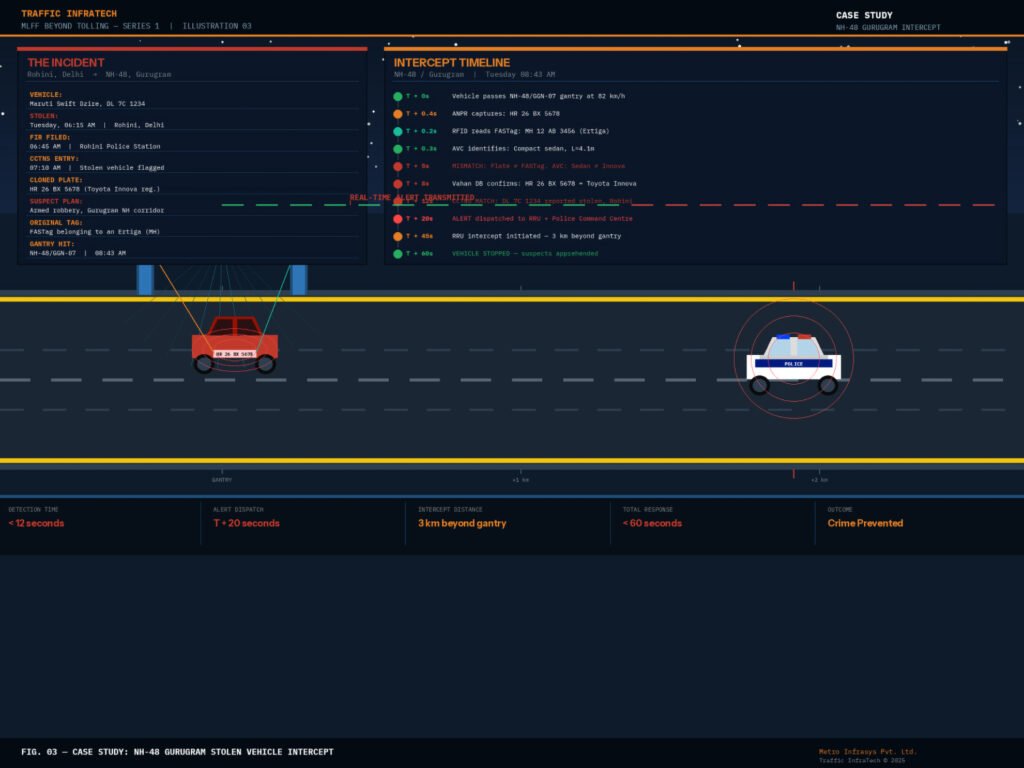
The following is a hypothetical but realistic scenario illustrating how the system would function in practice.
On a Tuesday morning, a Swift Dzire registered in Delhi — DL 7C 1234 — is stolen from a parking lot in Rohini. The owner files an FIR; the vehicle is entered into CCTNS as stolen. The thieves, intending to use the car in an armed robbery in Haryana, replace the number plate with a cloned plate — HR 26 BX 5678 — and drive south on NH-48.
The vehicle passes an MLFF gantry on NH-48 near Gurugram. The ANPR camera reads: HR 26 BX 5678. The RFID reader captures the FASTag — which is registered to a Maruti Ertiga under MH 12 AB 3456. Immediate red flag: the plate on the car does not match the FASTag registration.
The AVC sensor identifies the vehicle as a compact sedan, approximately 4.1 metres in length, consistent with a Swift Dzire or similar vehicle. The system queries Vahan: HR 26 BX 5678 is registered to a Toyota Innova — a large MPV, not a compact sedan. Second red flag: the physical vehicle type does not match the plate.
The system cross-references with CCTNS: DL 7C 1234 — the original plate for the stolen Swift Dzire — is active as a stolen vehicle alert.
Within 45 seconds of passing the gantry, a Rapid Response Unit receives the alert. The vehicle is intercepted 3 km beyond the gantry. The stolen car, the cloned plate, and the suspects are apprehended — before the robbery takes place.
From Detection to Intercept: A Timeline
• T+0 sec → Vehicle passes MLFF gantry at 80 km/h
• T+2 sec → ANPR plate captured, FASTag read, AVC vehicle type identified
• T+5 sec → Cross-check: Plate ≠ FASTag registration
• T+8 sec → AVC match check: Vehicle type ≠ Vahan record for displayed plate
• T+12 sec → CCTNS check: Plate flagged as stolen vehicle
• T+20 sec → Alert dispatched to RRU and police command centre
• T+45 sec → Intercept initiated 3 km beyond gantry
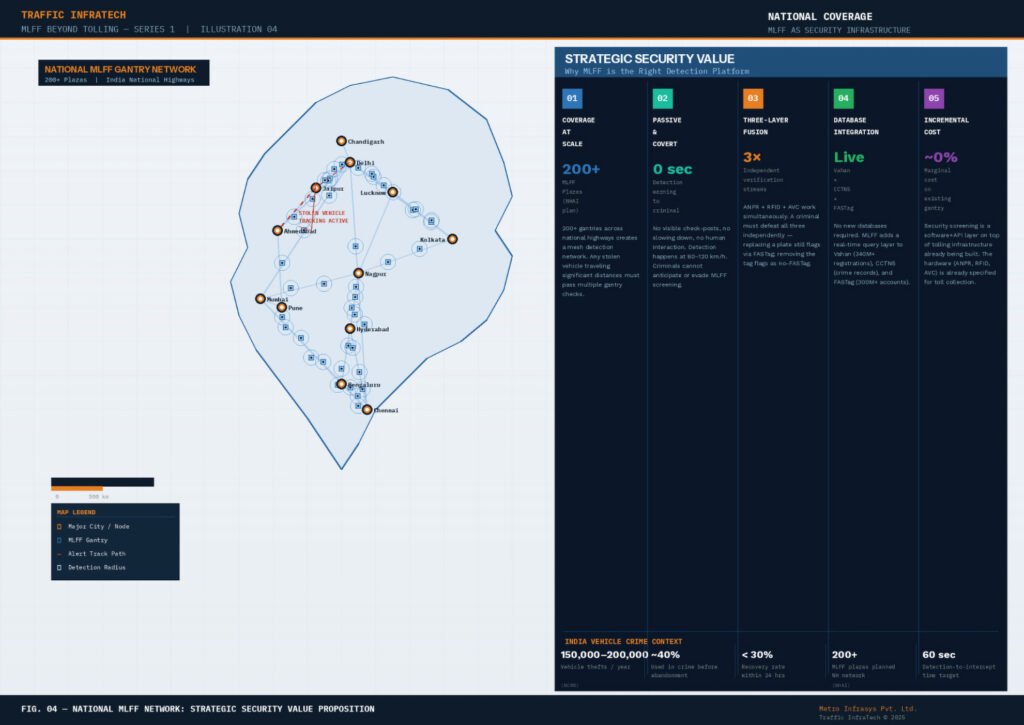
Why MLFF is the Right Platform for This Application
Scale and Coverage
With NHAI planning 200+ MLFF plazas, the coverage of the national highway network will be unprecedented. A criminal cannot travel significant distances on an NH without passing through multiple MLFF gantries, dramatically reducing the window for evasion.
Speed — No Traffic Disruption
Unlike traditional nakas or check-posts, MLFF gantries detect vehicles at highway speed. Criminals cannot slow down to avoid detection; there is no visual warning that a check is being conducted. The detection happens passively, invisibly, and instantaneously.
Data Fusion — Three Independent Checks
The combination of ANPR, RFID, and AVC creates three independent data streams that must all be consistent for a vehicle to pass without a flag. This multi-layer approach makes it extremely difficult for criminals to defeat the system — replacing a plate deceives the visual check but not the FASTag; removing the FASTag triggers a no-FASTag protocol; changing the FASTag without matching the plate triggers a plate-tag mismatch.
Integration with Existing Databases
India already has Vahan (vehicle registration), CCTNS (crime records), and FASTag (RFID-linked) databases. MLFF infrastructure simply adds a real-time query layer on top of these existing systems — no new databases need to be created, and no new data collection burden is placed on citizens.
Cost-Effective Deployment
The incremental cost of adding the security layer to MLFF gantries already being built for tolling is marginal. The sensors — ANPR cameras, RFID readers, AVC — are already specified for tolling operations. The additional investment is in the AI processing layer, database connectivity, and alert dispatch infrastructure.
“MLFF is not just a tolling technology. It is a national nervous system for our highways. It is time we treated it like one.” – Sachin Bhatia
Implementation Considerations
Privacy and Data Governance
Any deployment of vehicle tracking capability at national scale must be accompanied by a robust data governance framework. The data captured at MLFF gantries for security purposes should be subject to strict retention limits, access controls, judicial oversight for investigation purposes, and clear legal authority under Indian law. Public awareness and legislative frameworks must accompany technical deployment.
False Positive Management
No system is perfect. A plate misread by ANPR due to dirt, angle, or lighting can generate a false mismatch. The system must be designed with calibrated confidence thresholds — flagging only high-confidence mismatches for RRU intervention, and routing lower-confidence flags to post-event review. RRU personnel must be trained to handle intercepts professionally, with respect for individuals who may have been falsely flagged.
Database Hygiene
The effectiveness of this system is only as good as the quality of the underlying databases. Vahan records must be accurate and current. CCTNS stolen vehicle alerts must be entered promptly after FIRs are filed. FASTag-Vahan linkages must be maintained. Investing in database quality is as important as investing in the gantry hardware.
Operational Integration with Law Enforcement
The most sophisticated detection system is worthless without an operationally ready response. State police, highway patrol, and NHAI must develop joint Standard Operating Procedures (SOPs) for Rapid Response Units, alert thresholds, intercept protocols, and data sharing. Pilot deployments on high-crime highway corridors should be used to calibrate response times and refine operating procedures before national rollout.
Looking Ahead
The application— stolen vehicle detection — is one of the most immediate and impactful homeland security use cases for MLFF infrastructure. But it is far from the only one.
Each of the applications builds on the same foundational infrastructure — the MLFF gantry network that India is building for highway tolling. The question is not whether to build this infrastructure; that decision has already been made. The question is how intelligently we design and deploy it so that the investment delivers maximum value to the nation.