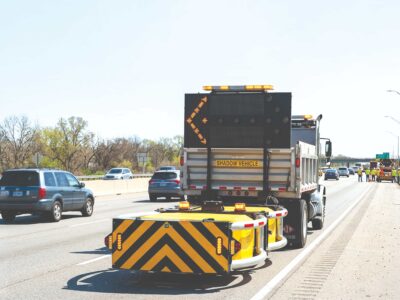

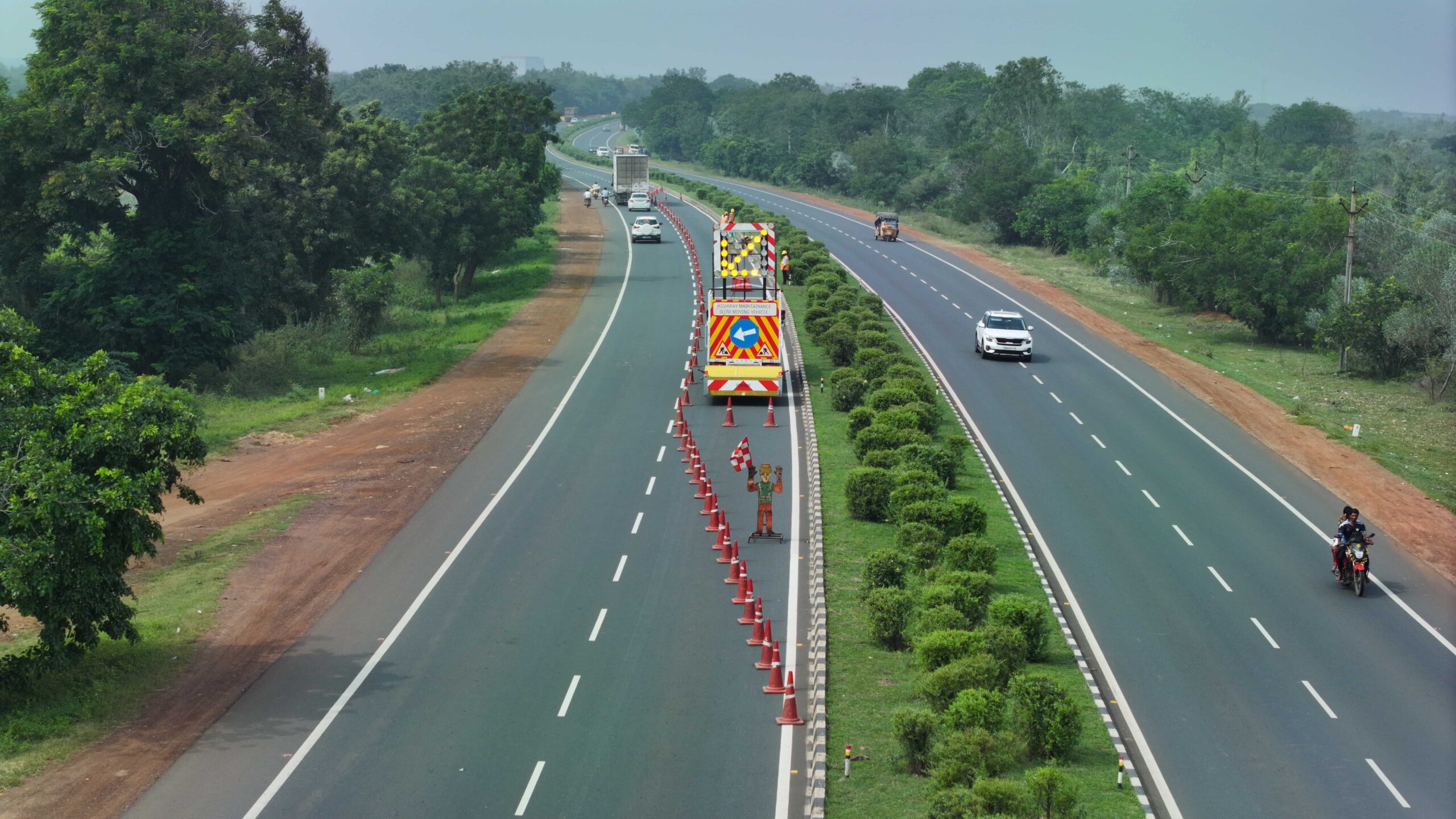

Vertis Infrastructure Trust and Safeway Concessions are among the most active deployers of Truck Mounted Attenuators (TMAs) on India’s national highways. TrafficInfraTech spoke to GVM Kiran Babu, COO, Vertis Infrastructure Trust, and Pawan Parikh, Chief Executive Officer, Safeway Concessions, on where the technology stands, what it has prevented on the ground, and where work zone safety is headed.
How widely have TMAs been deployed, and what does the rollout plan look like?
Beyond pilot-scale use, Vertis has deployed 27 Truck Mounted Attenuators across multiple national highway corridors and operational maintenance zones, covering 26 highway projects spread across eight states and protecting a cumulative highway length of over 7,324 km.

These deployments support routine maintenance, incident management, night works and mobile work zones — situations where workers are exposed to live traffic. “The strategy primarily focused on high-risk corridors where vehicle operating speeds are high and maintenance activities frequently require temporary traffic management arrangements, especially during night operations where visibility becomes critical,” says Kiran Babu.
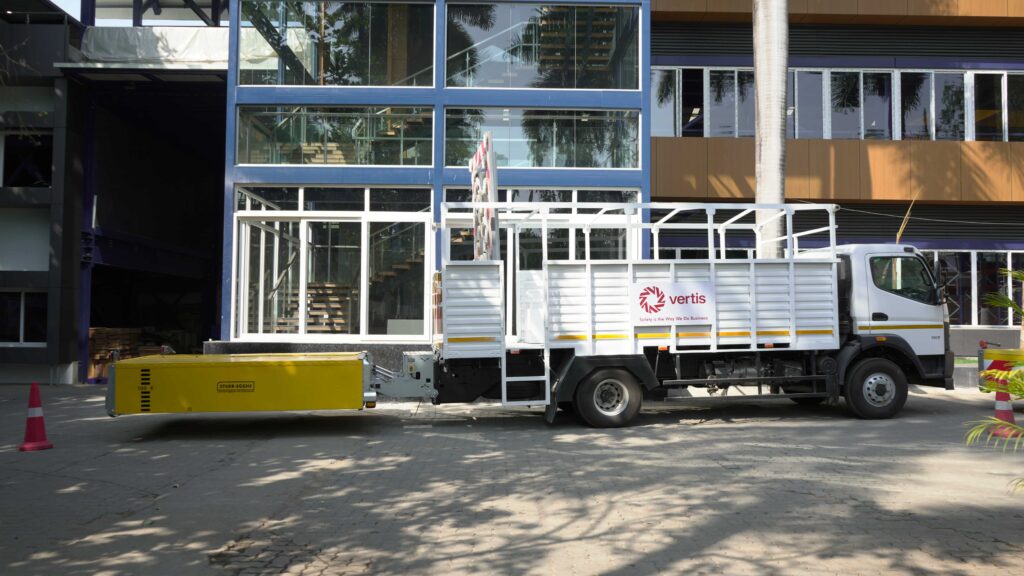
Safeway, which operates and manages nine national highway projects spanning roughly 681 km across Andhra Pradesh and Gujarat, has taken the count further on a smaller network, deploying more than 40 TMAs and Towable TMAs (TTMAs) integrated with wig-wag warning systems.
The units there are put to work across routine highway maintenance, rapid maintenance operations and temporary traffic management.
The operators see the present deployment as a base rather than a ceiling. Vertis plans to expand TMA deployment across its operational assets, with future plans including the integration of intelligent monitoring systems, enhanced visibility technologies and data-driven deployment strategies.
“Advanced engineering safety systems are not optional add-ons; they are fundamental to responsible highway operations,” says Parikh
What governs where and how a TMA is deployed?
Here the two operators are in close agreement, as they describe a structured, risk-based approach rather than blanket placement. Safeway integrates TMA deployment into its Work Zone Traffic Management Plan (WTMP), with every decision supported by an assessment of traffic volume, road geometry, the nature of the work activity, the speed environment and project-specific risk profiles.
Parikh lists the operational steps as:
• Site-specific work zone risk assessment and traffic condition analysis
• Identification of high-risk exposure areas requiring impact attenuation protection
• Deployment of TMAs as part of advance warning and channelisation arrangements
• Coordination with traffic marshals, signage, barricading and diversion management systems
• Periodic monitoring and repositioning in line with work progress and traffic movement
Vertis describes the same logic from the other side of the table. Its deployment philosophy is based on risk assessment, traffic volume, operating speeds, the nature and frequency of maintenance activity, visibility levels and worker exposure.
The shared objective is to create well-managed work zones that limit the consequences of a vehicle straying into an active site while keeping both road
users and on-ground personnel protected.
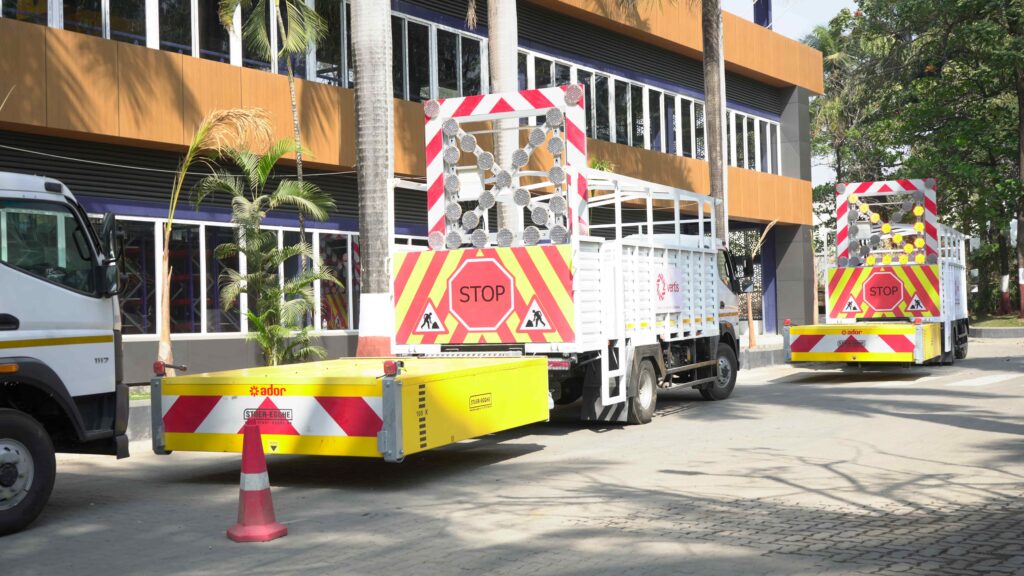
What crash-testing standards apply in India?
Both operators point to the same body of internationally recognised standards, and they note that India is steadily aligning with them. The common reference points are MASH (Manual for Assessing Safety Hardware) and NCHRP Report 350, with crash performance assessed at Test Level 3 (TL-3).
Vertis adds that relevant European EN standards, IRC recommendations and MoRTH specifications and work zone safety guidelines also feed into the framework, and explains that crash testing evaluates energy absorption performance, vehicle redirection behaviour, occupant risk, structural integrity after impact and post-impact stability.
Safeway draws out the Indian regulatory anchor in more detail. “Deployment of TMAs is also aligned with IRC: SP:55-2014, which governs work zone safety and shadow vehicles,” says Parikh, noting that the guideline recognises the use of ‘shadow vehicles’ to provide physical protection to workers, machinery and maintenance operations from rear-approaching traffic.
The Safeway units comply with MASH TL-3 and NCHRP 350 TL-3 and are engineered to withstand impacts at speeds of up to 100 km/h.
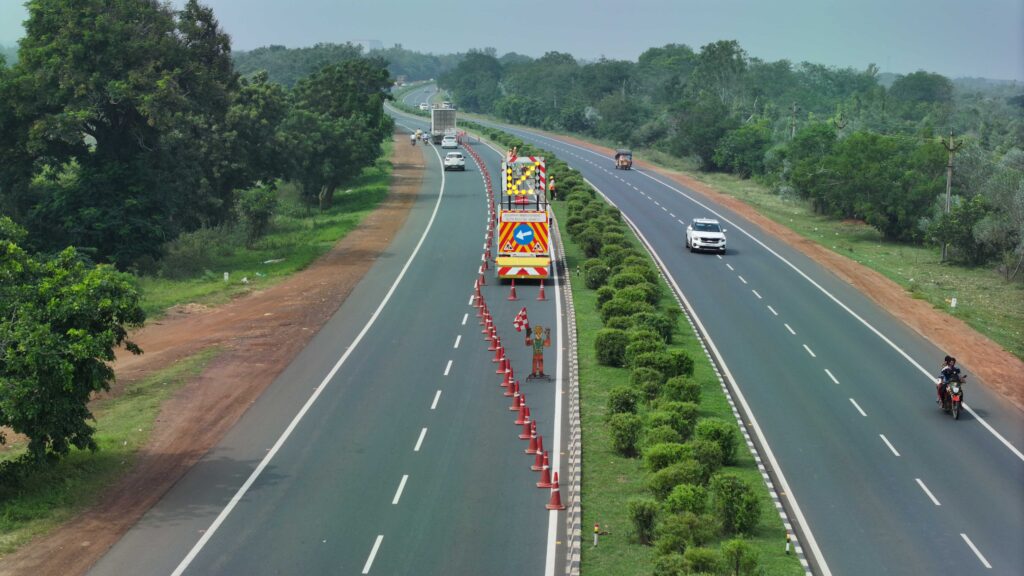
What does the technology actually do in an impact, and how has it advanced?
The working principle is the same across both fleets: the attenuator acts as a sacrificial barrier between live traffic and the work crew, progressively absorbing and dissipating crash energy in a rear-end collision so that far less force reaches the errant vehicle’s occupants and the workers stationed ahead of the zone. Safeway notes that the system also curtails the roll-ahead distance of an impacting vehicle.
The common features include:
• An advanced energy-absorption system that cuts impact severity during rear-end strikes
• A lightweight, high-strength structure that eases deployment without sacrificing protection
• A quick-recovery, modular design — Vertis points to replaceable components that reduce downtime, while Safeway highlights a deployment-and-recovery mechanism suited to both stationary and mobile
lane closures
• Enhanced visibility — high-intensity LED directional arrows, flashing beacons, reflective conspicuity treatments and arrow-board compatibility, all aimed at night and adverse-weather operations
• Reduced damage to the impacting vehicle and improved outcomes for road users
Vertis adds enhanced rear underride protection and reduced lifecycle maintenance to its list, the latter improving long-term operational availability for operators and contractors.
As Parikh sums up the direction of travel, the newer systems concentrate on crash-energy management, operational flexibility, driver and worker visibility and overall work zone safety — all of direct relevance to India’s high-speed, mixed-traffic environment.
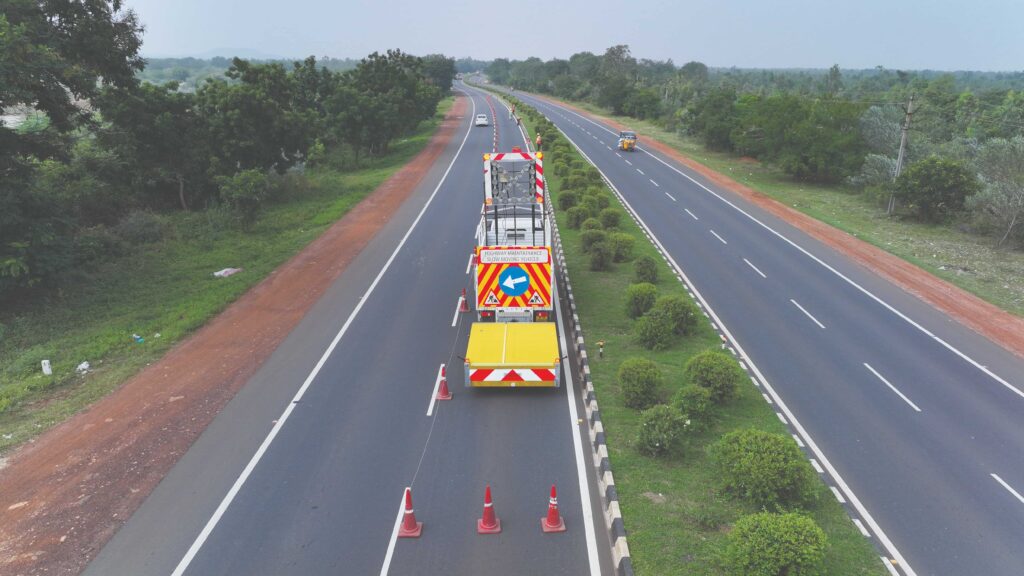
How effective have TMAs been in saving lives and reducing crashes?
Safeway reports 25 recorded collision incidents on its operational corridors in which the deployed TMAs and TTMAs absorbed the impact forces. “Critically, no fatalities or grievous injuries were reported in any of these incidents,” says Parikh, who credits the units with directly saving more than 137 lives of workers and road users otherwise exposed to serious risk.
Vertis is more conservative in its accounting. Within Vertis-managed work zones, the deployment of TMAs has helped save an estimated 10-15 lives across various project sites in recent years. Both international studies show reduced work-zone crash severity and documented Indian incidents where TMAs prevented direct strikes on maintenance teams and emergency responders.
“Our deployment philosophy is based on a simple principle: if a TMA absorbs even one major impact, it may already have prevented a life-altering event,” says Kiran Babu.
The TMA, thus, is an effective engineering safety control and an integral part of work zone traffic management, not a discretionary measure.
What kinds of crashes do they protect against?
Indian highway conditions, Parikh says, present a distinctive and demanding risk profile, given high traffic volumes, mixed traffic composition and operating speeds. Against that backdrop, the units have offered protection against:
• Rear-end collisions involving stationary or slow-moving maintenance vehicles
• High-speed vehicle intrusions into active work zones and lane-closure areas
• Crashes caused by driver distraction, fatigue, over-speeding or driving under the influence of alcohol
Vertis frames the protection in terms of the conditions that make Indian work zones hazardous in the first place — mixed traffic, higher levels of driver distraction, weak lane discipline, frequent night-time operations, a high proportion of heavy commercial vehicles and rapidly expanding construction activity. Read together, the two lists describe the same problem: an unforgiving traffic stream meeting a stationary or slow-moving work crew.
How does India compare with international benchmarks?
The operators place India some distance behind mature highway systems, while pointing to a clear upward trend. Vertis notes that several countries have institutionalised the use of TMAs as a standard component of temporary traffic management, whereas in India work-zone safety remains an evolving area that needs greater focus and standardisation. The encouraging shift, Kiran Babu says, is that concessionaires, infrastructure funds, regulators and contractors are increasingly treating work-zone safety as
a performance indicator rather than a compliance box to
be ticked.
What distinguishes the better-performing systems abroad:
• Higher levels of driver discipline, lane compliance and speed adherence
• Robust enforcement and real-time monitoring of work zone safety protocols
• Standardised, consistently applied temporary traffic control practices
• Near-universal use of crash-tested safety systems including TMAs, concrete barriers and portable signals
In other words, locate the gap less in the hardware — which is now broadly comparable — than in driver behaviour, enforcement and consistency of practice.
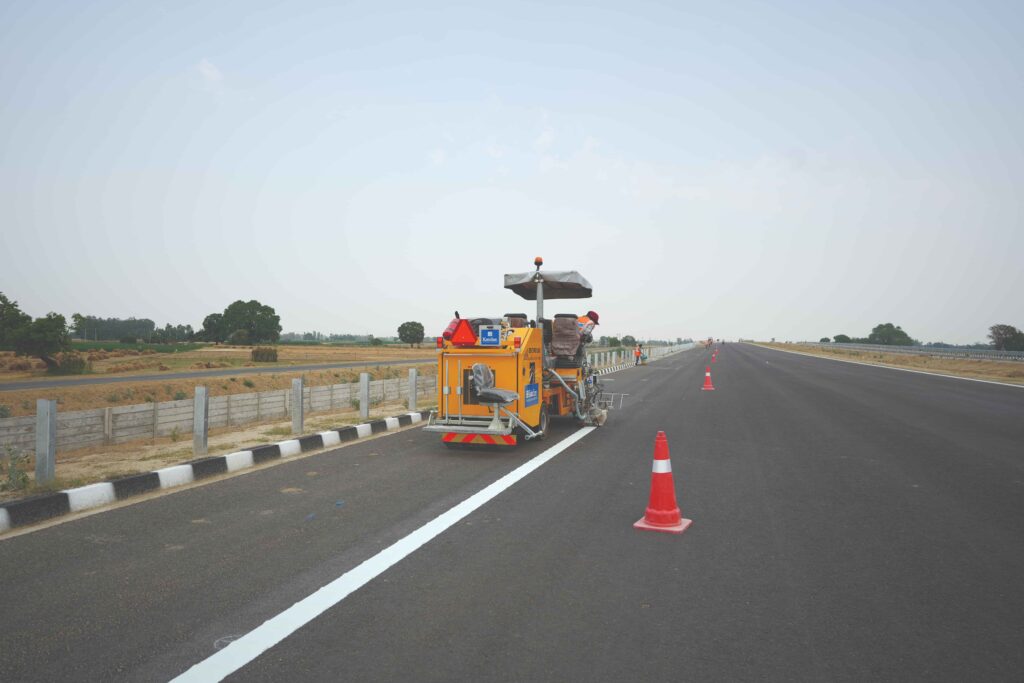
Are government policies aligned with the safety outcomes being sought?
Vertis and Safeway credit NHAI and MoRTH with raising the profile of highway safety. The policy direction is right while the execution still lags. Safeway points to a visible shift over recent years towards internationally accepted practices, including:
• Work Zone Traffic Management Plans
• Greater emphasis on Road Safety Audits across operational projects
• Enforcement of IRC safety standards, particularly IRC: SP:55
• Integration of safety provisions into project contracts
• Stronger requirements for temporary traffic management, lane-closure planning and worker protection
“The policy intent is sound; the priority now is execution at scale,” says Parikh, who identifies contractor awareness, enforcement capacity and the systematic adoption of advanced safety systems as the areas still needing work.
Vertis sets out a complementary list of where outcomes could be strengthened: wider mandating of TMAs for specified categories of maintenance and construction on high-speed corridors; standardised deployment protocols covering positioning, operating procedures, inspection frequency and operator competency; stronger performance monitoring, with measurable work-zone safety indicators written into concession agreements; and regular capacity-building for contractors, concessionaires, engineers and traffic-management teams.
Vertis argues that the benefits should not stop at national highways. State highways, urban expressways, industrial corridors and municipal road networks could all gain from these systems, with the structure and length of the TMA customised to the road category — and, Kiran Babu adds, real potential for adoption by State Road Development Corporations and Public Works Departments as awareness grows.
What does the next generation of intelligent TMAs look like?
On the future, the two operators are almost interchangeable — a sign of how settled the industry’s thinking has become on where the technology is heading. The shared vision is a connected, intelligent work zone in which the equipment not only protects workers during an impact but actively helps prevent crashes before they happen. The capabilities the operators expect to see integrated include:
• AI-based video analytics and work-zone surveillance — detecting stopped vehicles, queue formation, unsafe driver behaviour and intrusions
• Radar, LiDAR and sensor-based vehicle tracking for low-visibility and high-speed conditions
• Connected-vehicle (V2X) communication giving drivers real-time alerts on lane closures, mobile work zones and hazards
• GPS-based telematics and geo-fencing for continuous monitoring of TMA and work-vehicle positioning
• Smart arrow boards, Variable Message Signs and dynamic speed management linked to live traffic conditions
• Integrated command dashboards combining camera feeds, AI alerts, telemetry, weather inputs and incident monitoring
• Predictive maintenance monitoring and cloud-based safety dashboards
Parikh adds ADAS-enabled maintenance vehicles, dashcams, IoT monitoring and intelligent night-time lighting to the mix, but the destination describe is the same.
For all the differences in scale, network and figures, the two operators converge on a single message: TMA deployment is no longer optional but a core part of running a highway safely. As Kiran Babu puts it, “For Vertis, TMA deployment is more than an equipment investment — it is a commitment to creating safer highways and protecting frontline workers.”
The hardware is now largely in place and proven; the unfinished work lies in mandating it consistently, enforcing it on the ground and wiring it into the intelligent, connected work zones that India’s expanding highway network will need.